Home » 工业化学
硕士学位
工业化学
The Master of Science in Industrial Chemistry at TUM Asia is a 2-year full-time postgraduate programme delivered in Singapore, awarded jointly by the Technical University of Munich and the National University of Singapore.
Field of Study
工业化学
Degree Awarded
硕士学位
Study Mode
全日制课程
Programme Duration
4个学期;2年制
开学日期
August 2027
Application Period
1 Oct 2026 – 31 Mar 2027
Delivery Location
Singapore
授予学位的大学
Technical University of Munich
National University of Singapore
The Master of Science in Industrial Chemistry is competitively designed to nurture the next generation of specialist engineers and enablers in the pharmaceutical, fine, and specialty chemicals industries. This joint programme builds a strong foundation in catalysis, inorganic materials, reaction engineering, and polymer chemistry, with a strong focus on AI-driven automation and sustainability.
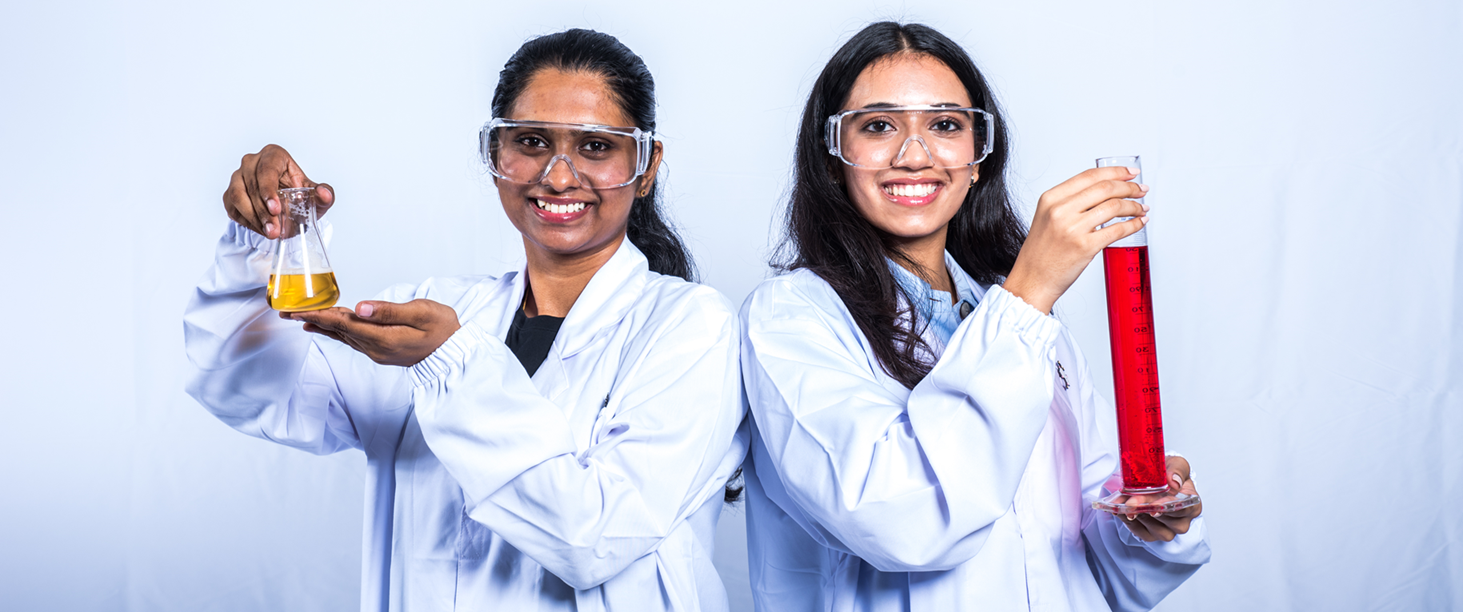
学生可以选择工业化学的三大支柱专业,即催化和石油化学、建筑和材料科学或两者的跨学科组合。他们将对有机金属化学、高级无机化学和聚合物化学有深入的了解。
催化与石油化学
建筑与材料科学
跨学科组合
2025年THE大学排名
学习成果
课程颁发与设立单位:







就业前景
其他职业领域包括:
- 研究与开发
- 聚合物科学家
- 工艺开发科学家
- 材料研究员
- 工业化学家
- Product Engineer in Pharmaceutical,
Fine and Specialty companies
成功故事
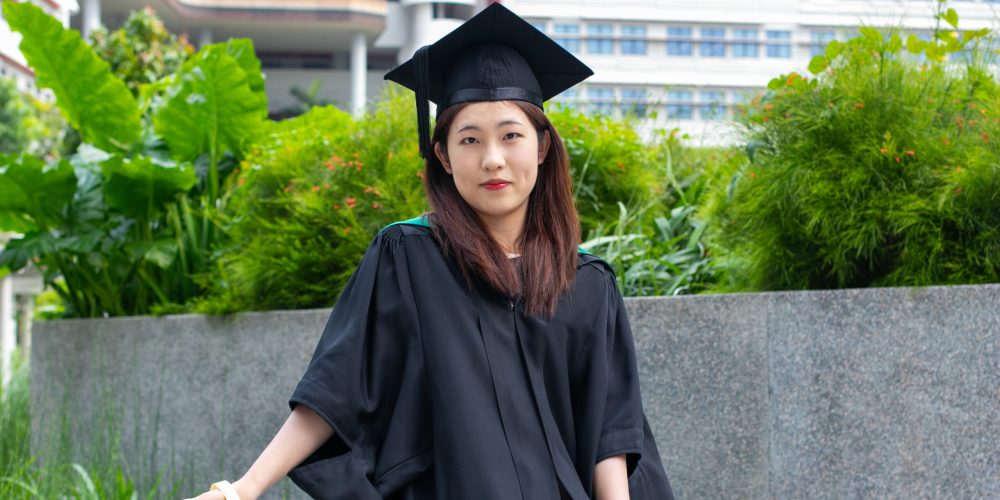
Jhanvi Madan
2024 届毕业生,工业化学理学硕士学位


课程结构
The MSc in Industrial Chemistry, totalling 120 ECTS, spans 4 semesters over 2 years, comprising a combination of required, technical and non-technical elective modules (75 ECTS), a 3-month internship (15 ECTS), and a Master’s thesis (30 ECTS).
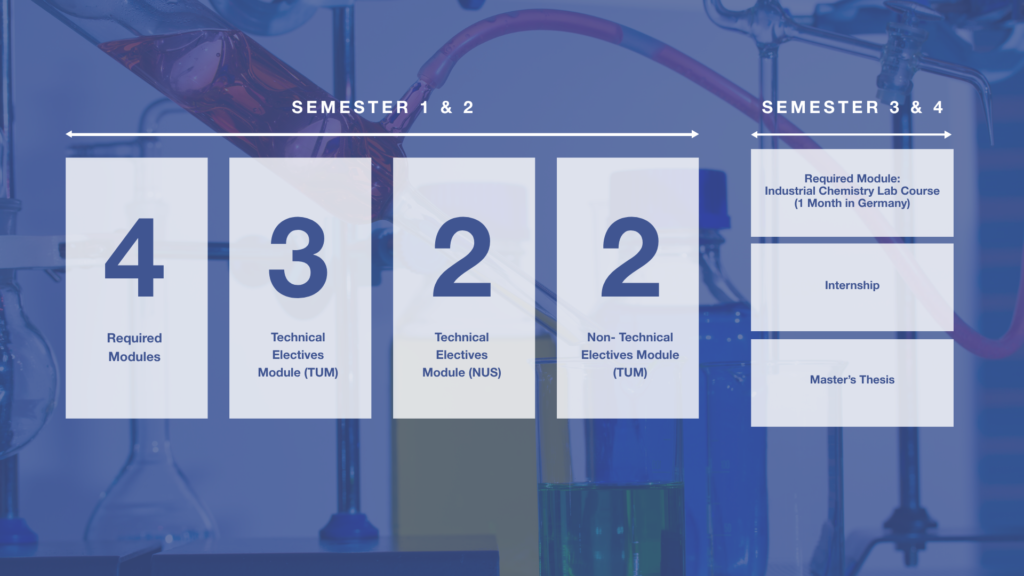
课程设置
Required Modules
Organometallic Chemistry and Molecular Catalysis
本模块涵盖以下主题:
- 有机金属化学导论
- 金属羰基络合物
- 金属烷基络合物
- 金属碳烯络合物
- 金属碳素络合物
- 一氧化碳和合成气体化学
- Oxidation Catalysis
- 加氢及相关反应
- CC 不饱和化合物的反应
- Industrial application of alkene, alkyne and aryne complexes
- Laboratory experiments in organometallic chemistry
Reaction Engineering for Industrial Applications
The scope of the course module is to enable students to understand the fundamentals of industrial chemical processes. This includes the principles of reaction (micro- and macro) kinetics, thermodynamics as well as mass and heat balances, performance equations, and residence time distributions in ideal and real reactors. Based on these concepts, processes in petroleum refining and petrochemical processes will be introduced, which include: Basics of crude oil chemistry, thermal and catalytic conversion and upgrading processes, production and management of hydrogen, as well as basic petrochemical processes. Laboratory experiments in unit operations.
聚合物和大分子化学
The course broadly covers the synthesis, characterisation and physical properties of polymers. The course will introduce various methodologies employed for the preparation and characterisation of polymers, followed by the physical properties of a range of polymers. The synthesis methodologies include details of radical and ionic polymers. The characterisation part will discuss various methods used for the determination of molecular weight, detection of amorphous and crystalline regions. The physical properties involve understanding the mixing and phase separation behaviour of polymer solutions. Other topics such as mechanical properties, degradation and recycling of polymers are included to provide an overall perspective of polymers.
Inorganic Materials Chemistry and Heterogeneous Catalysis
The first part of the lecture will introduce various types of inorganic materials, describe structures and syntheses of various material types, descibe structure-property relationships, with special emphasis on metals, superconductors, semiconductors including also band structure theory, description of defects, electrical and ionic conductivity in solids. Characterization techniques for inorganic materials will include X-ray diffraction methods, and differential thermal analysis (DTA). The second part of the lecture provides the fundamental concepts of heterogeneous catalysts. The kinetics and thermodynamics of sorption and (catalytic) reactions on the surface sites will be introduced. The surface chemistry, the reactivity, and materials aspects of metallic, acid/base, and redox catalysts will be described, as well as the preparation and characterization will be discussed using industrially relevant processes as examples. Laboratory experiments in inorganic materials.
Industrial Chemistry Laboratory Course
Technical Elective Modules
Data-Driven Automation and Robotics in Industrial Chemistry (TUM)
AI-Inspired Green Construction Using Advanced Chemistry (TUM)
本模块涵盖以下主题:
- Fundamentals of global warming – causes, effects, global strategies
- Contribution of construction & built environment to CO₂ emissions
- Fundamentals of artificial intelligence (AI) – concepts, major applications, market players
- Cement technology: how cement is produced, composition, chemistry, environmental impact
- Hydration of cement: chemistry, engineering properties of cement
- Application of AI to optimize cement properties and environmental impact
- Chemical admixtures for concrete: polymer synthesis, characterisation, effect on cement
- Classification of chemical admixtures: polycondensates, polycarboxylates, small molecules etc.
- Application of chemical admixtures in 3D printing of concrete using robots
- Future construction with robots: optimization based on AI
Drug Discovery Chemistry (TUM)
本模块涵盖以下主题:
- Introduction to the drug discovery pipeline.
- Presentation of different families of therapeutic agents (anticancer, antibacterial and antiprotozoal).
- Drug formulation and delivery. Pharmacokinetics & Pharmacodynamics concepts and information on the drug approval process in different countries.
- The various topics will be presented also with the help of case studies from literature.
Chemistry in Energy Conversion (TUM)
Chemical processes in conventional and renewable energy conversion will be discussed. A brooad general overview is provided before the lecture will cover in more detail catalytic processes related to energy conversion. It will be discussed how sustainble energy supply systems are supposed to be reached based on the current state of the art. In detail, the lecture covers classical catalysis in (petro)chemical and syngas/biogas conversion, chemistry in solar cells, photoelectrocatalysis, catalysis in electrochemistry (electrolyzers and fuel cells), and gas-solid photocatalysis for solar fuel synthesis.
Reactor Design and Process Intensification for Sustainable Chemical Engineering (TUM)
This graduate-level course delves into the principles and applications of chemical reaction engineering and reactor design with a strong emphasis on sustainability. Students will explore advanced topics combining reaction kinetics (knowledge from the core module) and transport phenomena, applying these concepts to the design and optimization of chemical reactors within the framework of process intensification. The course emphasizes the integration of sustainability principles, focusing on reducing environmental impact, enhancing energy efficiency, and utilizing renewable resources. Key topics include catalytic mechanisms, reactor modeling and simulation, and scale-up processes. Students will learn to design various types of reactors, such as batch, continuous stirred-tank, and plug flow reactors, fixed-bed, moving-bed and fluidized-bed technology as well as microreactor technology considering economic constraints. The course will cover life cycle assessment (LCA) and process intensification strategies to promote greener chemical processes. Through a combination of lectures and case studies students will develop the skills necessary to innovate and lead in the field of sustainable chemical engineering. By the end of the course, participants will be equipped to design and optimize reactors that not only meet industrial demands but also adhere to the principles of sustainable development, preparing them for roles in academia, research, and the chemical industry.
Industrial Bioprocesses and Technical Biocatalysis (TUM)
The module provides a broad overview of technically relevant biocatalytic processes. The main focus is on whole-cell biocatalysis from food to industrial high-value products. Both natural and recombinant whole-cell biocatalysis concepts / systems are covered in the course. After completing the module, students will be able to analyze the biochemical and bioprocess engineering principles of industrial biocatalysis in the field of biotechnological processes (enzymatic conversion, immobilization, processing of products) and apply them to related issues.
The course covers sustainability in the chemical industry, beginning with principles aligned with the UN SDGs and addressing environmental, economic, and social challenges. It introduces the 12 Principles of Green Chemistry, metrics like atom economy and E-factor, and strategies for sustainable process design, intensification, and efficiency. Life Cycle Assessment (LCA) and carbon footprinting are emphasized through case studies, alongside renewable feedstocks, bio-based processes, and catalysis approaches. Industrial bioprocesses, including applications in food, pharmaceuticals, and chemicals, are explored with examples like citric acid production.
The course also examines solvent alternatives, waste minimization, process safety, and energy integration through renewable sources and electrification. Emerging technologies such as photochemistry, electrochemistry, mechanochemistry, and CO₂ utilization are discussed, supported by industrial case studies and guest lectures. Practical components include lab experiments, simulation software (SimaPro, GaBi, Aspen Plus), and a group project where students redesign a traditional industrial process for improved sustainability.
Modern Analytical Techniques (NUS)
Please refer to the module description 此处.
Energy Storage and Conversion Chemistry (NUS)
Please refer to the module description 此处.
Emerging Concepts in Drug Discovery (NUS)
Please refer to the module description 此处.
Asymmetric Catalysis (NUS)
Please refer to the module description 此处.
Advanced Inorganic Electronic Materials (NUS)
Please refer to the module description 此处.
Advanced Organic Materials (NUS)
Please refer to the module description 此处.
Applied Computational Chemistry (NUS)
Please refer to the module description 此处.
Topics in Supramolecular Chemistry (NUS)
Please refer to the module description 此处.
Crystal Engineering (NUS)
Please refer to the module description 此处.
Advanced Organic Synthesis (NUS)
Please refer to the module description 此处.
非技术选修模块
工商管理
The module covers the following topics:
- Organizational forms of enterprises
- Financing instruments (equity financing, internal and external financing)
- Methods of capital budgeting (cost analysis, net present value analysis, internal rate of return analysis)
- Corporate valuation procedures (discounted cash flow analysis, multiple valuation)
- Methods and requirements of internal and external accounting (national and international accounting standards, origin and allocation of costs)
- Human resource management (forms of organizing, history of organizational research, human resource theories, motivational theories)
工业生产规划
Since manufacturers are confronted with special requirements of their production processes, like cycles, by-products, batches and campaigns, which are difficult to handle nowadays, this module deals with ERP software packages (ERP = Enterprise Resource Planning). Concepts of material requirements planning, supply chain management (SCM) combined with basics in cost accounting will be explained. As a highlight a simulation model, based on modern simulation software, will be used by students to simulate production planning and achieve the ‘best’ production plan.
创新与技术管理
The module covers the following topics:
- Innovation vs. invention
- Creating value through innovation
- Four forces of innovation
- Value to the customer and Hi-Tech Marketing
- Business system innovation and Service innovations
- Technological discontinuities, S-Curves and Scenario techniques
- Managing uncertainty and agility of enterprises
- Innovation, productivity and restructuring
- Venture capital, Start-ups and financing of innovation
- Innovation-driven economic cycles and Innovation impact on growth and jobs
工业市场营销
The module covers the following topics:
- Principles of marketing
- Marketing strategy and environment
- Creating customer value, satisfaction, and loyalty
- Information management and market research
- Analysing consumer and business markets
- Competition and differentiation from competitors
- Segmenting, targeting, and positioning
- Creating and managing products and services, brand management
- Pricing
- Marketing communications, marketing channels, and service P’s.
现代工业发展
The module will provide insights in the core elements of Industry 4.0 such as: introduction to Cyber-Physical System, Radio Frequency Identification (RFID) technologies, information collection with intelligent sensors, industrial networking to connect the machines and processes together, Manufacturing Execution System (MES) for order management, production control and value adding to the complete supply chain management.
知识产权与技术创业
This module will give a brief introduction to intellectual property rights, and focus on insights into general principles of patent law and international conventions governing the patent law. Current developments and criticism of the current patent law system will also be addressed. In addition, practical (legal) aspects of the commercialization of patents will be dealt with.
项目管理原理
This module introduces the principles of Project Management which addresses the key aspects of the project management processes and frameworks for successful projects. The skills and understanding of principles of project management is a key for the project manager to lead, plan, and implement projects to help their organizations succeed by achieving the common objectives within designated scope, cost, and timeline. The module introduces tools, techniques, and frameworks used to engage effective stakeholders’ communication, monitor the project life cycle, and consistently develop the project with its deliverable. In this course, the student will learn how to initiate, manage, monitor, and then close the project. Basic understanding of predictive and adaptive approaches commonly used in various projects and various industries.
*Disclaimer: Modules available for selection are subject to availability. Unforeseen circumstances that affect the availability of the module include an insufficient number of students taking up the module and/or the unavailability of the professor. TUM Asia reserves the right to cancel or postpone the module under such circumstances.
全球实习
通过实习获得真实世界的经验,您可以在世界任何地方的自己选择的公司积极争取实习机会。
实习计划体现了 TUM Asia 所有硕士课程的特点,学生有机会塑造自己的职业轨迹,并将理论知识付诸实践。学生将在与自己在 TUM Asia 学习领域相关的行业或学术机构完成为期三个月的实习。
实习可以在世界任何地方完成。
学生可以根据自己的职业目标和愿望,在世界任何地方的理想领域进行实习,并探索可能的职业发展途径。
Our Students’ Internship Experience :
[Fabian D’ Cruz]
[Occupation]
[Class of 2022, Master of Science in Rail, Transport and Logistics ]

硕士论文
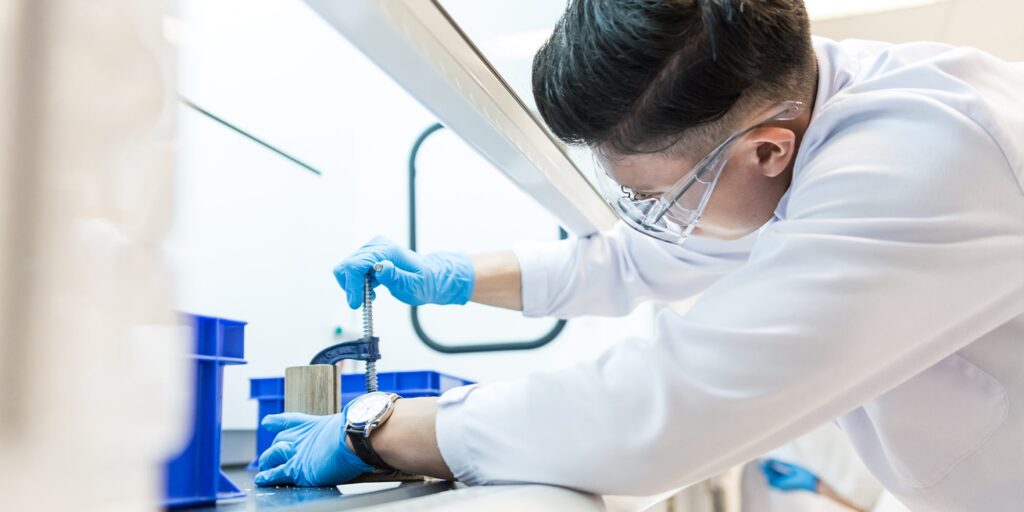
为期 6 个月的论文,让您能够将通过课程学习和研究助理获得的知识和技能运用到实践中去
通过这种有指导的学习体验,学生与行业伙伴或其他研究人员合作开展共同感兴趣的项目,并获得发表手稿的机会。
硕士论文完全以实践为基础。理论框架或概念模型偶尔可用于指导研究问题。
入学条件
Applicants to the Master of Science in Industrial Chemistry at TUM Asia must meet the academic and English language requirements set by the Technical University of Munich and the National University of Singapore. Admission is assessed based on applicants’ academic background, relevant preparation in engineering disciplines, and supporting documentation.
申请资格
申请人必须拥有化学工程、化学或密切相关学科的学士学位(至少完成三年学习)或同等学历,且成绩优异。
英文语言能力
非英语母语或过往学习经历(本科/高职文凭)授课语言不是英语的申请人,必须至少提交以下其中一项:
- 托福 (www.toefl.org): 最新的托福网络考试成绩至少为88*(托福代码:7368)
- 雅思 (www.ielts.org): 至少达到6.5分的学术雅思成绩
Akademische Prüfstelle (APS) 证书要求
持有中国、越南或印度大学学位的申请者,必须持有 Akademische Prüfstelle (APS) 证书。
TUM Online Matriculation Requirements
Incoming students are required to submit the following documents as part of TUM’s online matriculation process in their first year of study:
- PDF copy of a valid passport (personal particulars page only)
- Recent passport-size photograph
- 简历的PDF文件
- PDF copy of the notarised final academic documents, including the final certificate and transcripts.
- Any additional qualification-specific documents, where applicable
更多详细信息将在注册阶段分享。
For applicants whose native language or language of instruction from previous studies is not English, a TOEFL / IELTS score is required. For more information:
- TOEFL (www.toefl.org):
- IELTS (www.ielts.org):
IELTS
6.5
TOEFL
88+
For applicants with a Chinese, Vietnamese or Indian school or university degree, an Akademische Prüfstelle (APS) 证书。
For more information, please visit here.Link
费用与财务信息
Programme Fees
Please refer to the programme fees and payment schedule below. Kindly note that programme fees are payable separately to TUM Asia and the National University of Singapore (NUS), in accordance with the payment schedule provided.
| Programme Fees / Payable to | TUM Asia | NUS | Total |
|---|---|---|---|
|
报名费 |
S$5,450.00 |
S$2,725.00 |
S$8,175.00 |
|
Tuition Fee |
S$29,975.00 |
S$23,435.00 |
S$53,410.00 |
|
Final Amount (inclusive of GST) |
S$35,425.00 |
S$26,160.00 |
S$61,585.00
|
Payment Schedule – TUM Asia
| 第1期付款 | Due Date |
Payable Amount (inclusive of GST) |
|---|---|---|
|
报名费 |
接受录取时 |
S$5,450.00 |
|
第1期付款 |
15 July (Year 1) |
S$9,992.03 |
|
第2期付款 |
1 December (Year 1) |
S$9,992.03 |
|
第3期付款 |
1 July (Year 2) |
S$9,990.94 |
|
Total |
|
S$35,425.00 |
Payment Schedule – NUS
| 第1期付款 | Due Date |
Payable Amount (inclusive of GST) |
|---|---|---|
|
报名费 |
接受录取时 |
S$2,725.00 |
|
第1期付款 |
Mid of 5th instructional week |
S$10,355.00 |
|
第2期付款 |
Mid of 4th instructional week (Sem 2) |
S$13,080.00 |
|
Total |
|
S$26,160.00 |
- 所有费用均以新加坡元为单位,已包括根据《新加坡消费税法案》征收的现行商品与服务税(GST)。自 2024 年 1 月 1 日起,商品及服务税税率已调整为 9%。
- 学费取决于政府立法的变化或大学管理层的正式决定。学生将收到相应通知。
附加信息
学费还包含:
- TUM的注册费、教学费和考试费
- 实验室材料和费用
- 跨文化项目费用,可能包括活动门票和行业游览费用
- 所有教学材料的软拷贝文件
- 信息技术使用费: 上网费
- 游览和校外强制活动费用
- 使用TUM和 TUM Asia的所有设施
注册学生需支付以下费用:
- 学生医疗保险费(支付给 TUM Asia)
- 学生签证办理及签发费用(需支付给新加坡移民与关卡局 (ICA)
师资队伍








下载手册
感谢您对工业化学理学硕士专业感兴趣。
深入了解并探索您的机遇--立即下载我们的宣传册!
活动预告
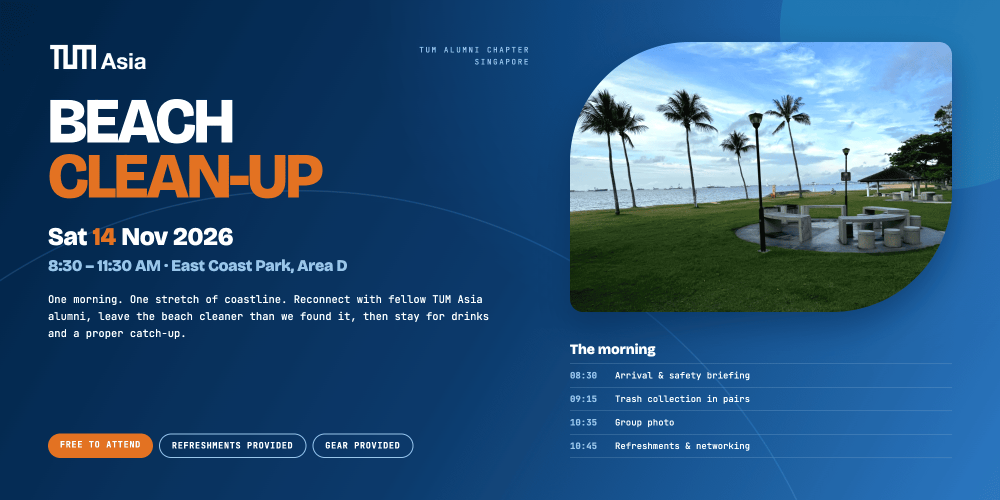
TUM Alumni in Singapore: Beach Clean-Up
- In-person | Singapore
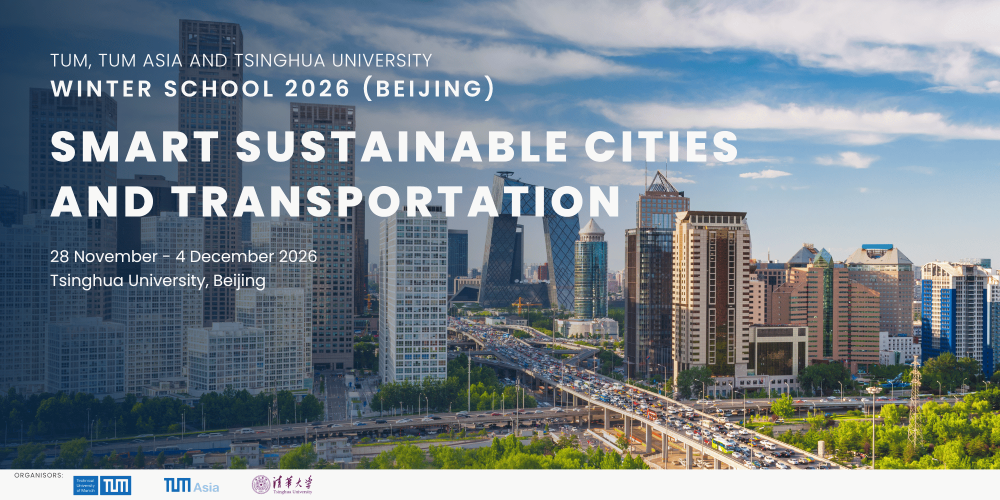
Winter School 2026 (Beijing): Smart Sustainable Cities and Transportations
- In-person | Beijing
Master of Science Programmes: Admission Webinar Series AY2728
- Online
Info Session AY2728: TUM MSc in SF & NUS-TUM MSc in IC
- Online
Info Session AY2728: TUM MSc in RUT & TUM MSc in LEM
- Online
Info Session AY2728: TUM MSc in AE
- Online
You May Also Like