

How an opportunity at TUM Asia quietly shaped a career and a way of seeing the world.
Arriving in jeans and a tee, Yitch fills the room with his energy. He is currently a Senior Manager at ST Engineering’s Artificial Intelligence/Data Analytics Strategic Technology Centre, also known (unofficially) as ‘Ratworks’, a reference to Lockheed Martin’s legendary ‘Skunk Works’. The name reflects both the nature of the work and the spirit of the team – unassuming, grounded, and focused on what matters.
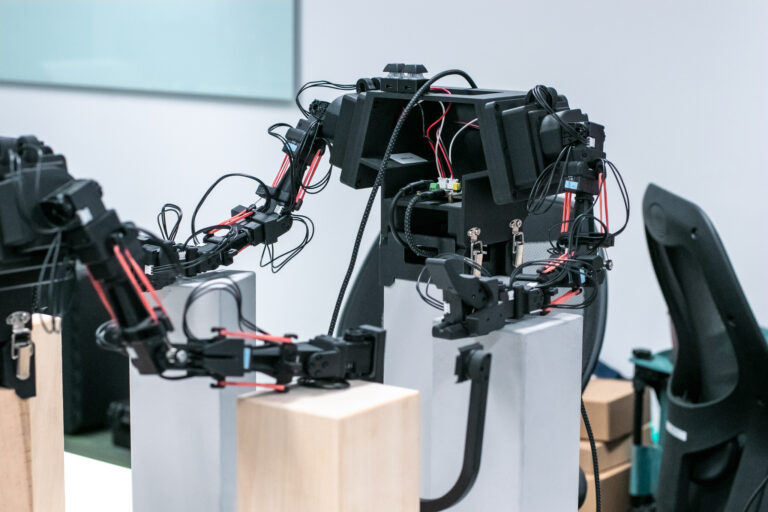
Working at the intersection of basic research and real-world application, the team identifies where emerging technology holds operational promise and steers it from lab to field across areas in defence to public safety.
An Unexpected Beginning
Yitch did not set out to pursue a master’s degree. It was 2010, in the wake of the global financial crisis, and he was navigating an uncertain job market. His professors at Nanyang Technological University (NTU), Associate Professor Seik Liter and Professor Chang Chip Hong, saw potential in him and encouraged him to apply for the TUM-NTU Master of Science in Integrated Circuit Design at TUM Asia. It was a moment of being seen at the right time and one he has never forgotten.
“[I’m] totally grateful [that they] asked,” Yitch says with a sense of gratitude that emulates his deep appreciation for Associate Professor Seik and Professor Chang. “Without [them], and without really getting the master’s, we wouldn’t have had the opportunity to work.”
His expectations of the programme at the time were modest but what he could not have anticipated was how much that door would continue to pay forward across his career journey.
A Cohort That Broadened His Perspective
Yitch’s course mates were primarily international and that diversity proved to be one of the programme’s most enduring gifts. Studying alongside peers across Asia, each bringing distinct educational backgrounds, cultural contexts, and approaches to problem-solving, gradually reshaped his perspective.
Beyond learning different cultural practices and ways of communicating, the deeper shifts came in the classroom. Yitch found himself challenged to rethink not just what he knew, but how he thought as his peers provided different thought processes and saw “the problem a lot faster.”
“Back then it was not immediately obvious,” he reflects, “but having studied alongside peers from different parts of the world, you come to realise how much there is to learn from one another — and how much richer your thinking becomes for it.”
That cross-cultural fluency has served him throughout his career, particularly in roles that required working across geographies and multicultural teams. He found himself better prepared than he had realised due to the daily practice of navigating differences that the programme had quietly provided.
“The folks came from top undergraduate universities like Peking University. The thought process is totally different … and the ability to have shortcuts and skip workings [were] fascinating.”
A Credential With Reach
Beyond the classroom, Yitch’s educational qualification from TUM Asia has opened doors that he continues to walk through. In global engineering and industry circles, particularly in Germany, the TUM branding carries weight that has proven professionally significant time and again.
One such moment came during his unexpected delegation trip to the Nordic countries as Yitch found himself being the only semiconductor specialist in the room. Arriving directly from an overnight flight and stepping straight into high-level discussions, he was the “only person who could go in depth and discuss about reliability studies” and his master’s thesis on time-frequency analysis. The rigour and depth of the programme had prepared him for a moment he had not seen coming.
Learning By Doing
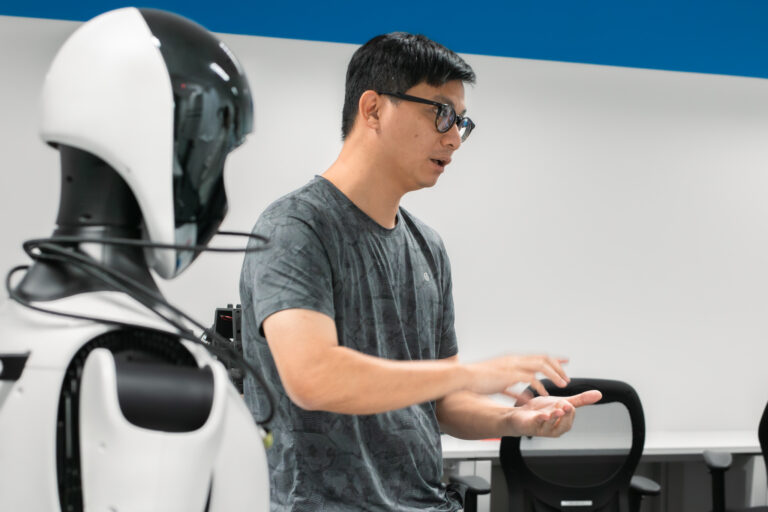
If there is a philosophy that runs through everything Yitch does, it is that you cannot truly understand something until you are in it. He draws on the concept of GEMBA, from the Toyota Production System and Lean methodology, which encourages one to be present and directly observe on-the-ground processes, not from a distance.
He applies this principle in farms and factories that he used to run to understand operations and returns periodically to work a shift at McDonald’s. These were his structured exercises in observing how processes evolve, teams are managed, and how design decisions play out at the ground level. “Management will only walk around,” he says. “But if you really do it, you really understand.”
It is the same instinct applied across every context of his, by staying curious and grounded.
Paying It Forward
Yitch did not enter TUM Asia with a carefully mapped plan. He came because someone believed in him at a moment when his path was uncertain. Not immediately obvious in its value, the programme provided him with a globally respected academic qualification, peers who gave different perspectives and challenged how he worked, amongst others. It became clear over time in the rooms it allowed him to enter and the conversations it equipped him to have.
That sense of having been given an opportunity shapes how he thinks about giving back. For Yitch, contributing to the alumni community is about extending the same kind of access and support that once made a difference to him. He approaches it with the same humility that defines everything he does. “If there’s a need for help, I’m happy to extend,” he says. “That’s what this community is for.”
His advice is simple – do not be afraid to fail, do not chase titles, and always find meaning in the work you are doing, as the rest has a way of following. “No point looking backwards,” he reflects. “Find the best out of every situation.”