
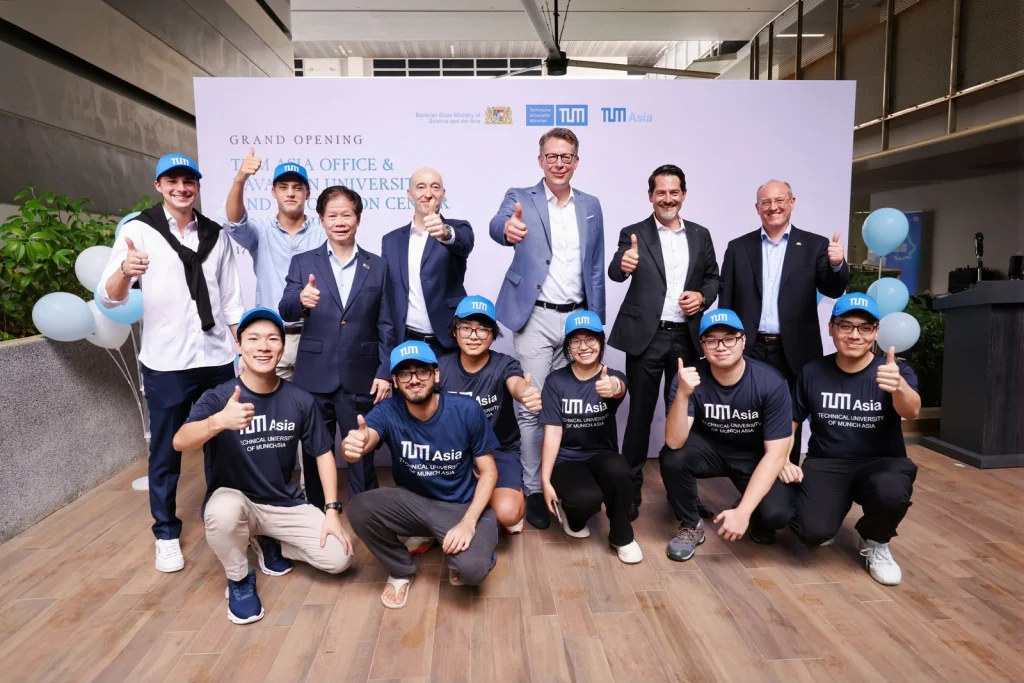
Bavarian State Minister for Science and the Arts, Markus Blume and President of the Technical University of Munich (TUM), Prof. Thomas Hofmann, travelled all the way from Bavaria to officially open TUM Asia’s new premises. At the same time, the ceremonial ribbon was cut for the new BayAP Office (Bavarian University and Innovation Center Asia Pacific). With this office, the Free State of Bavaria aims to strengthen the presence of Bavarian universities across the Asia-Pacific region.
To conclude the celebrations on a high note, a traditional lion dance delighted the audience, an auspicious finale symbolising success for both initiatives.
It is no coincidence that the Technical University of Munich is the only German university to operate its own overseas campus with teaching activities in Singapore, educating around 1,000 students. Much like the city-state itself, TUM consistently ranks among the top in international university rankings and is recognised globally as a leading institution, particularly in engineering and the natural sciences.
To learn more about TUM Asia, I meet Dr. Markus Wächter, Executive Director of TUM Asia and Vice President TUM Asia, TUM, in Punggol. Located in the far northeast of the city-state, the highly modern campus of the Singapore Institute of Technology (SIT) houses TUM Asia’s second and smaller site. The mathematician, who holds a PhD, offers insights into the history of the institution.
How did the collaboration between Singapore and TUM come about?
We have been active in Singapore since 2002. At the time, the long-serving TUM President Wolfgang Herrmann sought to position the Technical University of Munich internationally. He had Singapore in mind, having visited the country previously and appreciating its strategic location in Asia and its high academic standards. At the same time, Singapore’s Economic Development Board (EDB) was reaching out to European universities. One could therefore describe this as a classic push-and-pull factor.
Initially, TUM Asia offered only Master’s programmes. The aim was to attract talented students from across the region to Singapore and subsequently integrate them into the local labour market after graduation. At the same time, TUM sought to train skilled professionals for German companies operating in Asia. Since 2010, we have also been offering Bachelor’s programmes, and with TUMCREATE we have established our own research institute here in Singapore.
What were the challenges in the early years?
The learning curve at the beginning was very steep, and there were many challenges to overcome. As a public university, TUM is not allowed to transfer funds to Singapore, which means that we must operate as a financially independent entity. We finance ourselves primarily through tuition fees. In the early years, we also received funding from the Singapore government, the German Federal Ministry of Education and Research (BMBF), and the German Academic Exchange Service (DAAD). The DAAD continues to support us strongly through scholarships.
When selecting our academic programmes, we closely align them with the dominant industries in Singapore, such as chemicals, logistics, and semiconductors. This ensures that our graduates can find suitable employment opportunities. We also had to learn how best to approach our target audiences and effectively market our offerings.
How did you personally come to TUM Asia?
I grew up in the Upper Palatinate region of Bavaria and studied mathematics. After completing my doctorate in aerospace engineering at TUM, I came to Singapore in 2004 for a one-year postdoctoral position at the National University of Singapore (NUS). Shortly before my return to Germany, TUM approached me and asked whether I would be interested in helping to build TUM Asia. I have been with TUM Asia since 2005.
What do you value about Singapore as a research location?
The Singaporean government has recognised how essential education and research are for the city-state. Senior government leaders, such as former Deputy Prime Minister Heng Swee Keat, are actively involved in the Research, Innovation and Enterprise (RIE) programmes. The National Research Foundation reports directly to the Prime Minister.
Like Germany, Singapore lacks natural resources and faces a stagnating population. As a result, it invests heavily in education and research and is able to act swiftly. Successful collaborations and projects are closely monitored, and the framework conditions are adjusted when necessary. The focus is less on basic research and more on results-oriented research.
Different areas of urban development such as smart cities, energy technology, and food security, are closely linked to research priorities. This approach is, of course, easier in a city-state without federal structures, but I would welcome Germany learning from this model. Singapore has also succeeded in attracting top talents, such as TUM alumnus and EDB Managing Director Jermaine Loy, into public service.
What are your visions for TUM Asia?
It is my strong wish to bring TUM Asia together in a single building as a visible and unified campus in the foreseeable future. I would also like to further expand our partnerships with Singaporean universities such as NTU, NUS, and SIT, as well as increase the number of TUM-owned programmes.
We aim to grow our student population from 1,000 to 1,500 over the coming years. Beyond teaching and research, we would like to further strengthen innovation and entrepreneurship by creating an ecosystem that supports startup creation—an area in which TUM is particularly strong. We also plan to continue expanding our presence regionally.
What do you enjoy about Singapore? What are your hobbies?
I actually see Singapore’s hot climate as an asset. When I wake up in the morning, see the sun, and feel the warmth, it feels like being on holiday. I enjoy living near Bukit Timah Nature Reserve, appreciate Singapore’s cultural diversity, and value the proximity to wonderful travel destinations in the region.
In my limited free time, I most enjoy spending time with my family. I also practise taekwondo and enjoy photography.
Dr. Wächter, thank you very much for this insightful conversation.