
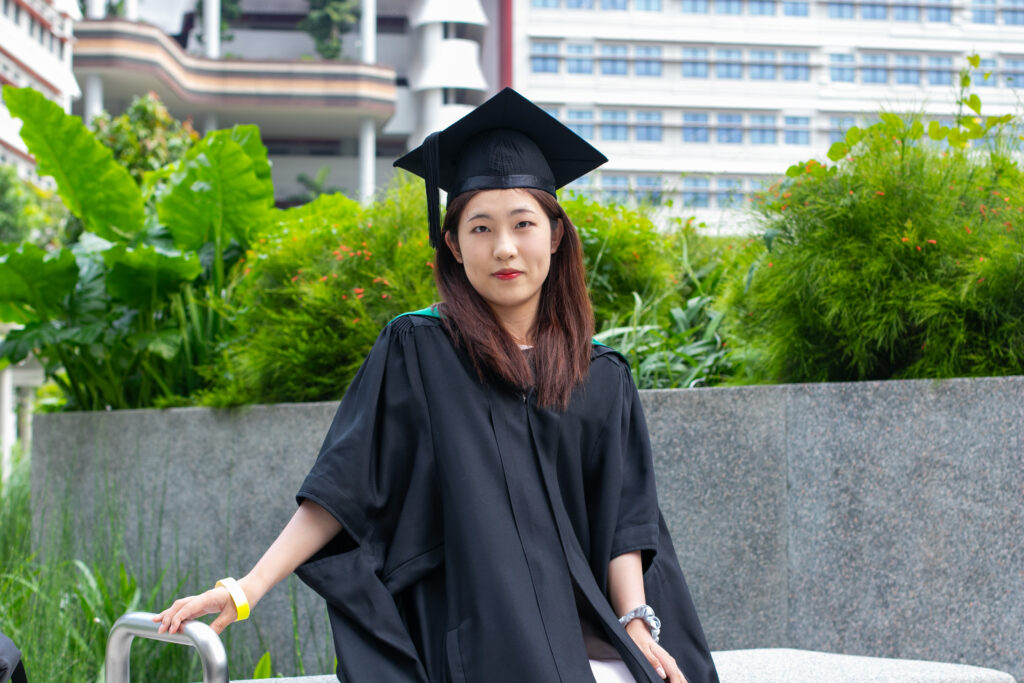
Curiosity, perseverance and the habit of asking the right questions have taken Lu Hongyu from the laboratory classroom to an award-winning research project.
This year, Hongyu graduates with a Master of Science in Industrial Chemistry from TUM Asia and receives the Best Thesis Award, recognition not only of an outstanding piece of research, but also of the mindset behind it.
For Hongyu, pursuing a master’s degree was never simply about earning another qualification. She wanted to bridge academic knowledge with practical application and prepare for a career solving real engineering problems.
“The programme stood out because of its flexibility,” she explains. “Students can choose to complete their internship and thesis either in academia or in industry, depending on their career goals. That opportunity to apply classroom knowledge to real-world challenges was exactly what I was looking for.”
The joint degree offered by TUM and NUS also gave her access to the academic strengths, teaching approaches and international perspectives of two globally recognised universities.
Learning to Ask “Why”
Although Hongyu entered the programme with a strong academic foundation, she soon realised that succeeding at TUM Asia required a different way of thinking.
A laboratory class with Dr. Alson became a turning point. Instead of simply checking whether students had followed the correct procedures, the class challenged them to explain the scientific reasoning behind every decision.
“In my previous studies, I focused on following the instructions,” she recalls. “At TUM Asia, I realised I needed to understand why each step mattered.”
From then on, each experiment became an opportunity to investigate: Why is this reagent added? Why is the reaction carried out at this temperature? What happens when the conditions change?
This habit transformed the way Hongyu approached learning. Rather than memorising procedures, she sought to understand the underlying scientific principles. She prepared thoroughly before laboratory sessions and discussed ideas with lecturers and classmates.
The same approach extended beyond the laboratory. In Professor Fässler’s Inorganic Materials class, students regularly solved problems on the board and explained their reasoning to the class.
“It taught me that understanding isn’t just about getting the correct answer,” she says. “It’s about being able to explain it clearly to others.”
Turning Research into a Real-World Solution
Hongyu put this mindset into practice during her research and development internship at Saint-Gobain.
While helping to develop a new filter product, she experienced the full innovation cycle, from reviewing scientific literature and patents to designing experiments, analysing results and optimising product performance.
Progress demanded patience. Experiments rarely unfolded exactly as planned, requiring repeated analysis, adjustment and refinement.
“Product development isn’t about finding the right answer immediately,” she says. “It’s a continuous process of testing, learning and improving.”
Successfully validating the product’s feasibility became one of the defining moments of her master’s journey. Seeing her research contribute to a practical engineering solution reinforced her ambition to become an Application Engineer, using scientific knowledge to address customers’ technical challenges.
Industry visits to Evonik Singapore, Wacker and Sika Singapore further showed her how classroom concepts are applied in manufacturing and research environments—and what is expected of professional engineers.
The Perseverance Behind an Award-Winning Thesis
Receiving the Best Thesis Award remains one of Hongyu’s proudest achievements. Yet behind the recognition were months of uncertainty and persistence.
“There were times when I worried that I wouldn’t obtain meaningful data or develop results that could lead to a practical product,” she admits.
When experiments failed to produce the expected results, Hongyu did not give up. She examined each setback, refined her approach and continued improving the work step by step.
Looking back, she believes the award represents far more than the final research outcome.
“It recognises the persistence, continuous improvement and scientific thinking throughout the entire research process.”
Hongyu also credits her supervisor at Saint-Gobain and Professor Hinrichsen for the guidance, encouragement and support that helped her navigate the project’s challenges.
Carrying the Question Forward
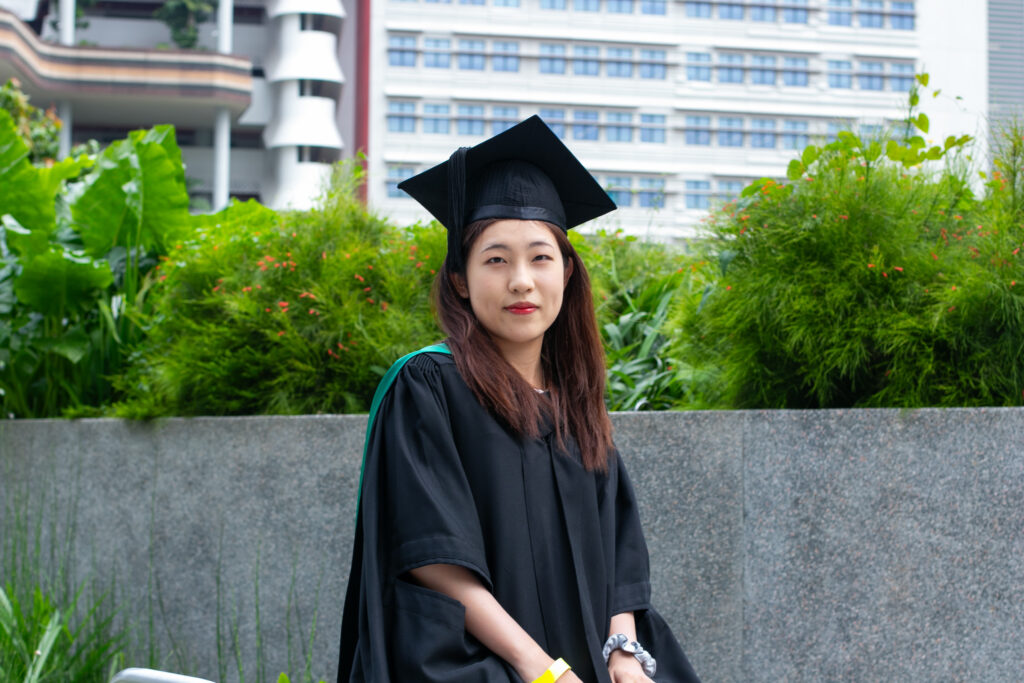
Hongyu will soon begin her career as an Application Engineer at Galaxycore, bringing with her the technical expertise, research experience and problem-solving mindset developed at TUM Asia.
In the years ahead, she hopes to become a trusted technical advisor who can connect customer needs with innovative engineering solutions while continuing to learn and grow.
For future TUM Asia students, her advice is simple:
“Stay curious, be proactive, and don’t just focus on getting the right answer. Focus on understanding why. Every assignment, laboratory session and project is an opportunity to learn.”
It is a philosophy that carried Hongyu from her first laboratory class to an award-winning thesis. As she begins her professional journey, one question will continue to guide her: Why?
Passionate about solving real-world challenges through chemistry? Explore how TUM Asia’s Master of Science in Industrial Chemistry equips students with critical thinking, research expertise, and industry exposure to develop innovative solutions and excel in careers across the chemical and advanced materials industries.