
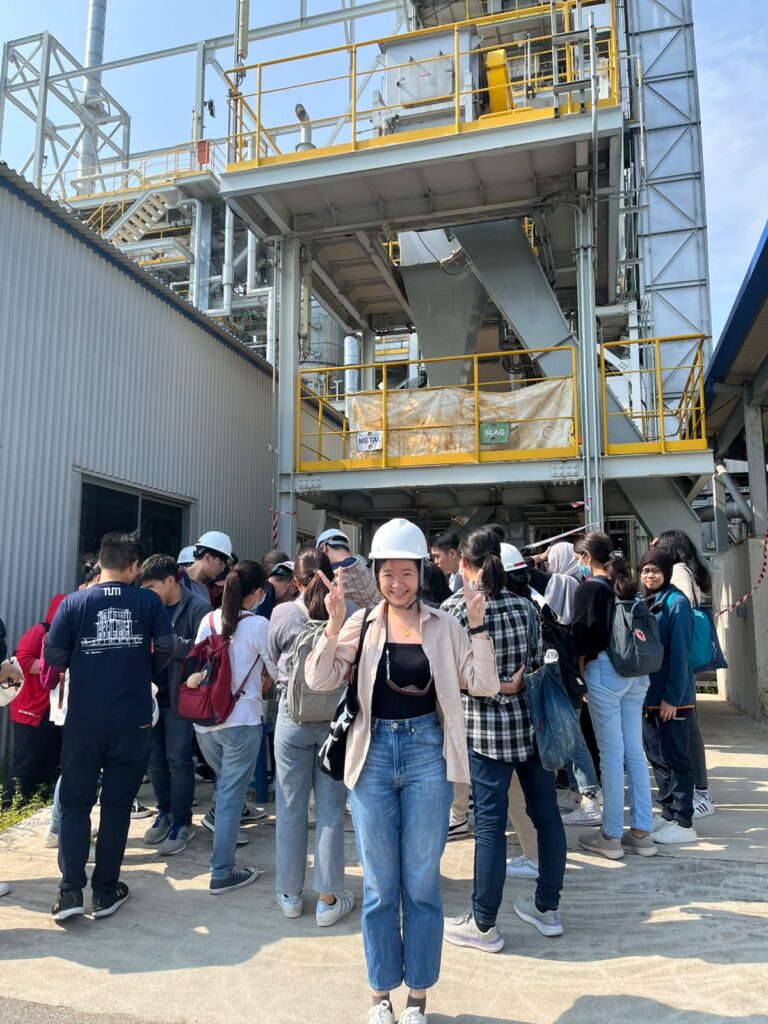
When Rachel began her undergraduate degree at SIT-TUM Bachelor of Engineering (Honours) in Chemical Engineering in 2020, she was drawn in by a straightforward instinct of wanting to solve real-world problems, particularly in manufacturing and healthcare.
The joint degree programme allowed her to think at scale, break complex systems into manageable parts, and apply scientific principles to practical, large-scale challenges.
“Chemical engineering trained me to be a systematic critical thinker,” she says. It was a disciplined, expansive way of approaching the world and it gave her a foundation she would consistently rely on.
Deepening, Not Departing
By the time she completed her undergraduate degree, Rachel’s interest had been steadily narrowing towards chemistry’s direct role in pharmaceutical and materials development. The TUM-NUS Master of Science in Industrial Chemistry was the natural next step in furthering that interest. Both fields, she explains, emphasise applying scientific principles to scalable solutions. The progression felt less like a pivot and more like a deepening.
The master’s programme delivered depth as it taught her to slow down and examine things far more closely through experimental work and reaction mechanisms.
Three topics in particular built the bridge, preparing her for her internship ahead: an organic chemistry lab course that sharpened her experimental instincts; a polymer and macromolecular chemistry course that gave her a working vocabulary in material selection for healthcare applications; and a materials chemistry and engineering module that connected mechanical behaviour to real-world outcomes like release kinetics and device durability.
When she was awarded a TUM Asia scholarship during her master’s programme, it marked another kind of shift in her. “I feel recognised for my hard work and dedication,” she reflects. Beyond the practical support, it gave her confidence that she was capable of reaching further than she had previously allowed herself to imagine.
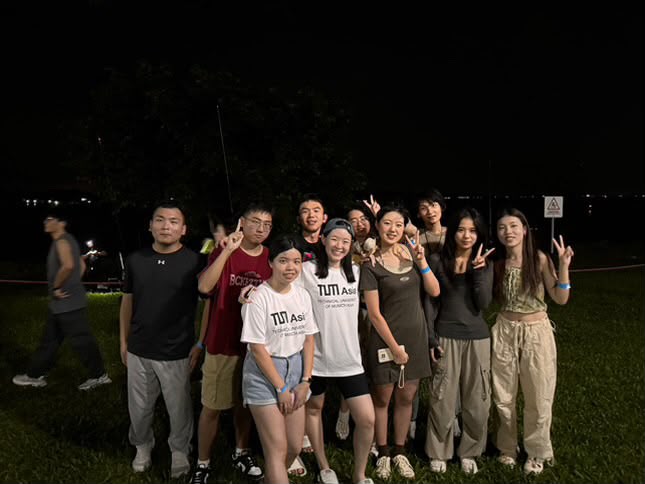
The curriculum was only part of the picture. Rachel had the opportunity to also learn from her cohort made of peers from across Asia and beyond, each bringing their own background and way of thinking into the room. “It has been such a joy,” she reflects.
A conversation she had with her classmates about the futures they were building and a shared sense that anything was possible, gave her a nudge that guided a change in someone who had always felt that her path was more or less mapped out. “I was never adventurous enough to take a leap away from Singapore,” she shares, “but through that, I felt encouraged to do the same or … try something outside my comfort zone.” That encouragement led her to explore an overseas internship.
“I was never adventurous enough to take a leap away from Singapore,” she shares, “but through that, I felt encouraged to do the same or … try something outside my comfort zone.”
From Theory to Practice
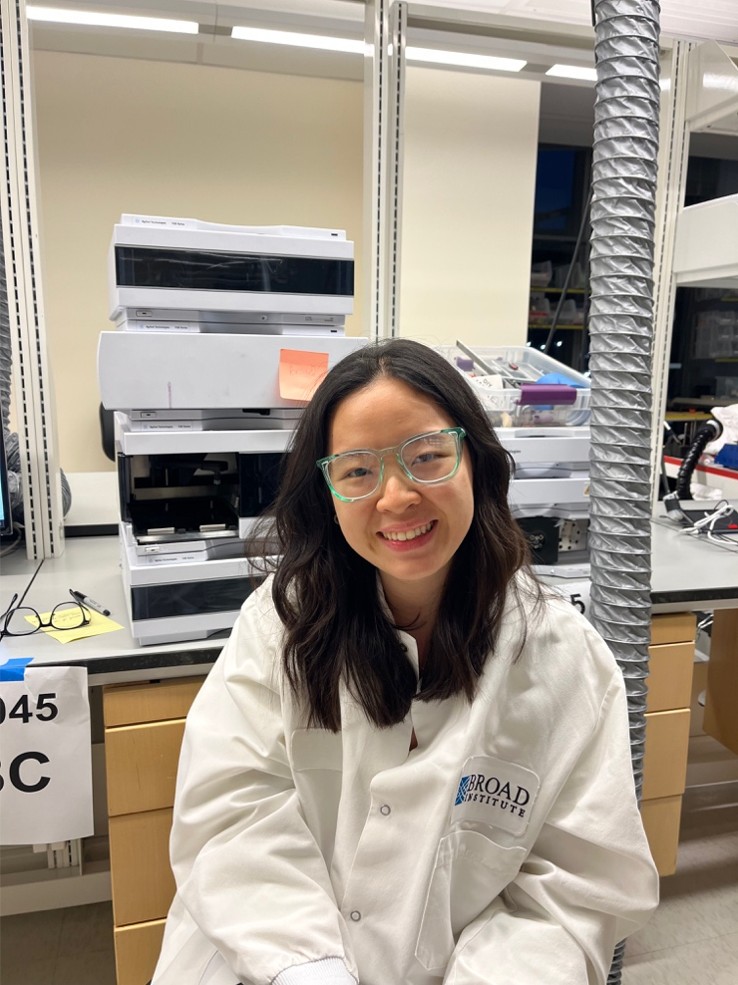
Where did that leap take her? Rachel landed an internship opportunity at the Harvard Medical School and Massachusetts General Hospital as a research intern, applying material science principles to medical device development.
The day-to-day is concrete and demanding. Depending on where a project stands, she might spend her time manufacturing devices in the lab, planning and conducting animal experiments, characterising material samples, or sitting with researchers to troubleshoot ongoing challenges. Data analysis, reproducibility, and clear reasoning behind every conclusion are naturally expected.
And here’s where both of her degrees show up. Her first encounter with a real lab came during an undergraduate internship at A*STAR Institute of Materials Research and Engineering (IMRE) in 2023, where she got her first glimpse of science beyond the classroom and its potential real-world applications. “It gave me a whole new perspective of science,” she recalls. That experience, combined with the analytical depth she built through her master’s, meant that by the time she arrived at Harvard Medical School and Massachusetts General Hospital, she wasn’t starting from scratch. “My background in both fields has refined my thinking and troubleshooting skills,” she says.
Not only that, TUM Asia had also prepared her for the ambiguity of real research.
“I didn’t fully appreciate how TUM Asia taught me to think independently under ambiguity until I was in the thick of my internship. In hindsight, those projects were building my ability to break down unfamiliar problems and work through issues without a defined path.”
What She Carries Forward
As Rachel prepares to graduate in 2026, what comes next is still taking shape. She’s weighing continued research against industry roles, with healthcare as her anchor in either direction. But whatever path she takes, she knows what travels with her.
“The ability to adapt, think and collaborate across different cultures and walks of life” is something Rachel will carry forward.
For her, graduation also marks a personal transition from textbook-focused student to one applying her foundations in complex, real-world research. As she steps into that identity, she joins a community of TUM alumni who graduated from the Singapore campus, carrying the same foundation into their own unfolding paths.
For students standing at the crossroads of internships and opportunities, she offers this: “Have an open and curious mindset,” she says. “The world is your oyster; you are in control of your own path. If given the opportunity, try taking a step outside your comfort zone and see where life takes you.”